

Uranus
Credit:NASA
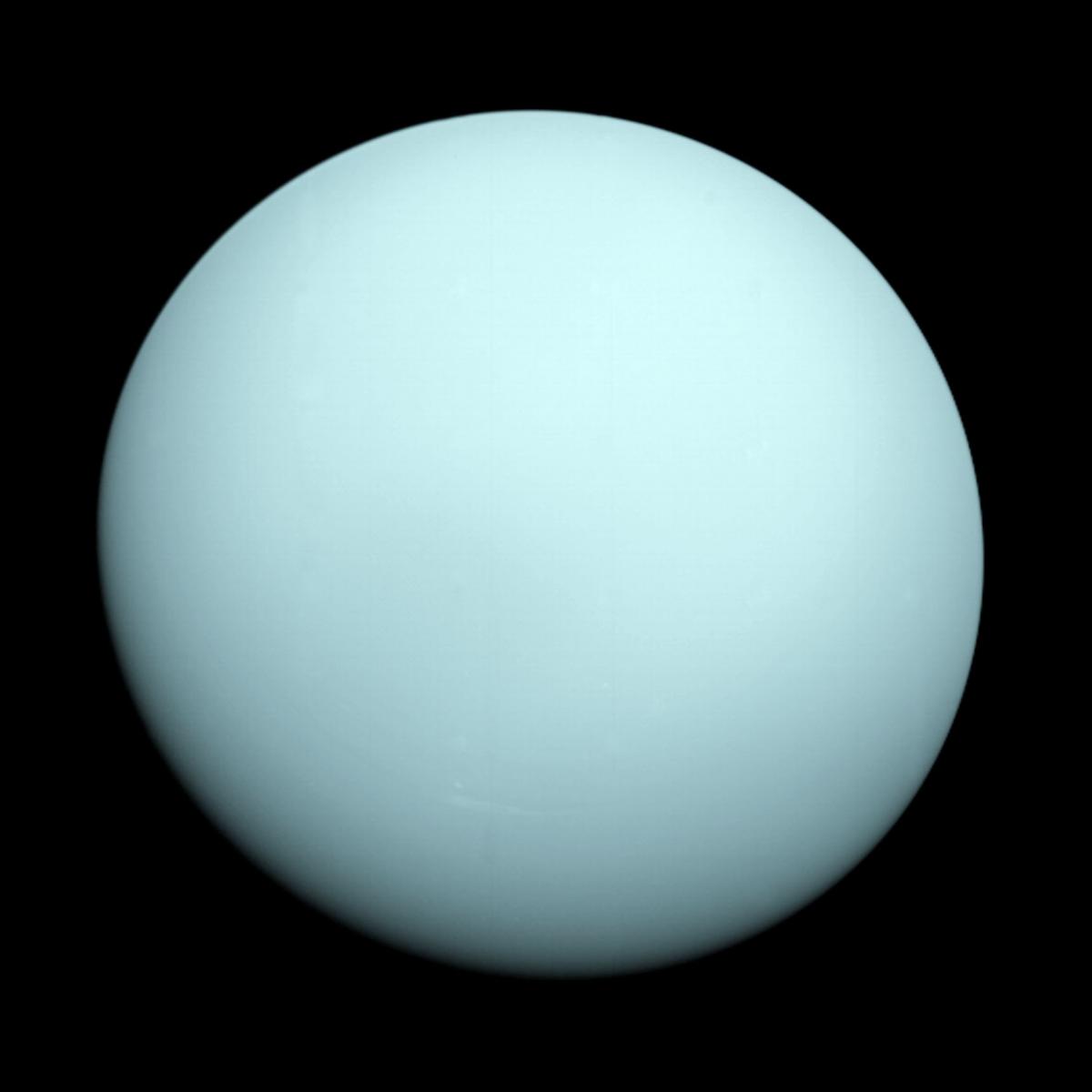
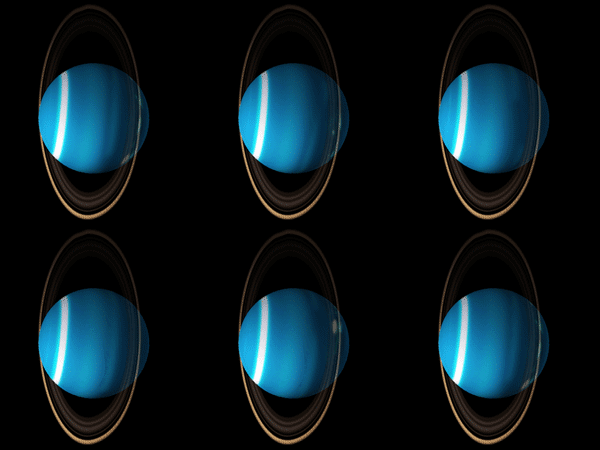
Uranus is the seventh planet from the Sun. It is the third widest planet in our Solar System after Jupiter and Saturn. But Neptune has more mass than Uranus because Neptune is denser. Uranus is an ice giant, made of slushy liquid and ice, with a small rocky core. Like Saturn, Uranus has rings, but Uranus' rings are fainter.
The slushy ice on Uranus is made of methane, water and ammonia. Uranus also has a thin atmosphere made of hydrogen and helium, plus methane. The methane gives the planet its blue-green colour. Parts of Uranus' atmosphere are as cold as -220 °C, which is even colder than Neptune! The wind on Uranus can be as fast as 900 km per hour! Pictures of Uranus often show a smooth featureless surface. But if we look at Uranus using infra-red light, we see bands of cold clouds and warmer spots.
Uranus takes about 17 hours to spin once on its axis. Like Venus, Uranus spins the opposite way compared to the other planets. It takes Uranus about 84 Earth years to orbit the Sun once.
Uranus is unusual because its equator tilted over 90° compared to its orbit. This makes the planet look like it's spinning on its side. Uranus is the only planet in our Solar System that does this. Scientists think a planet-sized object hit Uranus long ago and knocked it over onto its side.
Credit:Almond/NASA
Uranus has 27 moons. Most of its moons are very small and orbit close to Uranus. The five largest are further out from the planet. They are called Miranda, Ariel, Umbriel, Titania and Oberon. Uranus' moons are named after characters from the works of William Shakespeare and Alexander Pope.
Uranus was the first planet found using a telescope. William Herschel was the first person to see Uranus in 1781. At first, he thought he had seen a comet or a star. Another astronomer called Johann Elert Bode confirmed Herschel's discovery of a 'new' planet. Herschel wanted to name the planet 'Georgium' after England's King George III. Bode suggested the name 'Uranus' from the Greek god of the sky.
Uranus has only been visited by 1 space probe. The spacecraft Voyager 2 flew passed the planet in 1986.