User login

Image of the Month

Here we showcase the best monthly images obtained during the past year by the Liverpool Telescope. If you feel that you have obtained a particularly good observation, then please let us know. You can see earlier 'Images of the Month' at the IOM Archive.

January 2012

Date:

Telescope:

Observer:

Description:

03/01/12 - 21:31 GMT

Liverpool Telescope

The Ridgeway School

We have decided to select two images this month, in order to demonstrate how the appearance of the Copernicus Crater on the Moon changes dramatically over the course of just four days. This is due to the Sun shining on it from different angles, which also causes the various phases of the Moon we see.

Copernicus Crater on the Moon
Download LTImage observations: 3483D000.hfit : 3483D002.hfit
December 2011

Date:

Telescope:

Observer:

Description:

01/12/11 - 01:37 GMT

Liverpool Telescope

Instituto de Astrofisica de Canarias

This month we have a 3-colour image of an irregular galaxy called NGC 1961. The galaxy's unusual shape is most likely due to a past collision with another large galaxy, but because no other culprit is visible in the vicinity, the two galaxies are thought to have merged into one. Dust lanes are visible around the core.

NGC 1961
Download LTImage 3-Colour observations: 3293F000.hfit (R) 3293F001.hfit (G) 3293F002.hfit (B)
November 2011

Date:

Telescope:

Observer:

Description:

18/11/11 - 03:04 GMT

Liverpool Telescope

Honley CE Junior School

We have seen lots of good Moon images this month, but we choose this one because of the long shadows being cast across the lunar surface. The shadows in the largest crater, in particular, show that the crater edge is much rockier than one might expect. These shadows can be used to measure the height of features.

Section of the Moon
Download LTImage observation: 3220H000.hfit
October 2011

Date:

Telescope:

Observer:

Description:

25/10/11 - 23:49 GMT

Liverpool Telescope

Tapton School

Here we have a 3-colour image of just part of the reflection nebula known as IC63. Most of the time these clouds of gas and dust go unnoticed, however, IC63 is being illuminated by the nearby bright star called Gamma Cassiopeia, which doesn't actually appear in the frame. The clouds are most likely remnants from the original nebula from which the star formed.

IC63 Nebula
Download LTImage 3-Colour observations: 3105J000.hfit (R) 3105J001.hfit (G) 3105J002.hfit (B)
September 2011

Date:

Telescope:

Observer:

Description:

26/09/11 - 20:53 GMT

Liverpool Telescope

Royal Observatory Greenwich (Student)

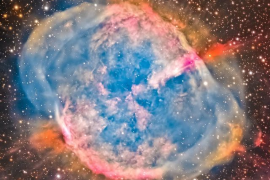
This month we have a 3-colour image of a planetary nebula called the Dumbbell Nebula, or M27. It was first discovered in 1764, when astronomers of the day thought its round shape meant that it was planetary in nature. We now know that planetary nebulae are low mass stars in the final stages of their lifetimes.

M27
Download LTImage 3-Colour observations: 3056H000.hfit (R) 3056H001.hfit (G) 3056H002.hfit (B)
August 2011

Date:

Telescope:

Observer:

Description:

27/08/11 - 00:33 GMT

Liverpool Telescope

Caistor Grammar School

This month we have selected a region of space, known as BD65_1637, that contains a number of newly formed hot, blue stars emerging from a cloud of gas and dust (a nebula). Essentially, the region is a stellar nursery that is slowly transforming into an open cluster. Note that more distant stars appear red because red light passes through dust more easily than blue.

BD65_1637
Download LTImage 3-Colour observations: 2982F000.hfit (R) 2982F001.hfit (G) 2982F002.hfit (B)
July 2011

Date:

Telescope:

Observer:

Description:

08/07/11 - 22:19 GMT

Liverpool Telescope

University of Bangor

This month we've chosen a rather nice image of the Moon's surface. The large crater to the lower-middle of the image, known as Ptolomaeus, is 153 km in diameter and around 2.4 km deep. Unlike the two large adjacent craters, it has no central peak, and exhibits a relatively smooth base that was flooded by lava in the early history of the Moon; in the same way that the Mare (lunar seas) were formed.

Moon
Download LTImage observation: 2888E000.hfit
June 2011

Date:

Telescope:

Observer:

Description:

12/06/11 - 03:24 GMT

Liverpool Telescope

Instituto de Astrofisica de Canarias

This 3-colour image shows part of NGC6888, the Crescent Nebula. The nebula is created by a hot, blue-giant star (not in the field-of-view) in the final stages of its life, which is expelling the outer layers of its atmosphere at an extremely high rate and will eventually go supernova. The redness of the cloud indicates hydrogen gas.

NGC6888
Download LTImage 3-Colour observations: 2765B000.hfit (R) 2765B001.hfit (G) 2765B002.hfit (B)
May 2011

Date:

Telescope:

Observer:

Description:

29/05/11 - 22:54 GMT

Liverpool Telescope

The Brooksbank School

Here we see a 3-colour image of the central region of the Whirlpool Galaxy, formally known as NGC 5194 or M51. This galaxy is a classic example of a spiral galaxy. The clumpy blue regions in the emerging spiral arms mark out areas where new stars are being created. The central core appears redder in comparison because it contains older and cooler stars.

NGC5194
Download LTImage 3-Colour observations: 2799D000.hfit (R) 2799D001.hfit (G) 2799D002.hfit (B)
April 2011

Date:

Telescope:

Observer:

Description:

12/04/11 - 22:23 GMT

Liverpool Telescope

Royal Greenwich Observatory (Student)

The weather in La Palma hasn't been that great during April, but we did manage to get this rather nice image of the Moon's surface. The large crater to the left of the image, known as Copernicus, is 93 km in diameter and around 1 km deep. The three central peaks rise to about 1.2 km above the base of the crater. That's not far off the height of Ben Nevis.

Moon
Download LTImage observation: 2661B000.hfit
March 2011

Date:

Telescope:

Observer:

Description:

29/03/11 - 04:57 GMT

Liverpool Telescope

Formby High School

This 3-colour image is of a Planetary nebula known as the Ring Nebula, or M57. These are low-mass stars shedding the outer layers of their atmospheres as they end their lifetime. The layers of different colours we see are shells of different elements being ejected. The hot blue core of the star (now called a white dwarf) can still be seen in the middle.

M57
Download LTImage 3-Colour observations: 2589I000.hfit (R) 2589I001.hfit (G) 2589I002.hfit (B)
February 2011

Date:

Telescope:

Observer:

Description:

13/02/11 - 06:03 GMT

Liverpool Telescope

Barrow-in-Furness Sixth Form College

This month we have another spiral galaxy to show you, but a particularly stunning example. NGC 4501 (or M88) is located 47 million light-years away in the constellation of Coma Berenices. This 3-colour image (created using LTImage) shows that the galaxy core is made of older cool-red stars, whereas younger hot-blue stars occupy the spiral arms.

NGC 4501
Download LTImage 3-Colour observations: 2480B000.hfit (R) 2480B001.hfit (G) 2480B002.hfit (B)