

Venus
Credit: Almond/NASA
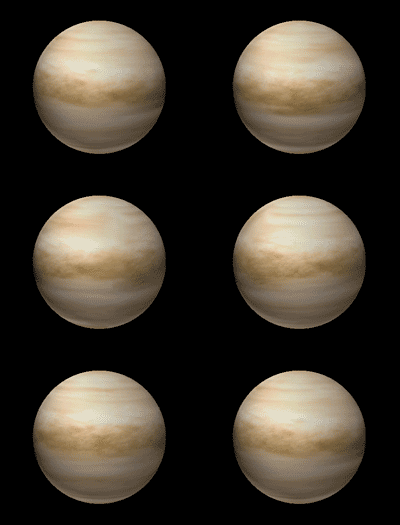
Venus is the second planet from the Sun. Like Mercury, Earth and Mars, Venus is a terrestrial planet. It has a solid surface and is mainly made of rock. Venus is third smallest planet in the Solar System. It's similar in size to the Earth but a bit smaller. Venus is the second brightest natural object in the night sky. Only the Moon is brighter.
Venus has a thick toxic atmosphere. This mostly made of carbon dioxide plus clouds of sulphuric acid. The thick clouds stop heat from escaping and have caused a runaway greenhouse effect. This makes Venus the hottest planet in our Solar System even though Mercury is closer to the Sun! The temperature on the surface of Venus can get as high as 462 °C. Because Venus' atmosphere is so thick, the air pressure on the ground is more than 90 times that of Earth. You'd have to dive a mile down into Earth's ocean to feel a similar pressure!
Venus has short years but very long days compared to Earth. It only takes Venus 225 Earth-days to orbit the Sun, but it takes Venus 243 Earth-days to spin once on its axis. We call the amount of time to complete one rotation, a sidereal day. However, because Venus is also moving around the Sun, the sun rises every 117 Earth-days! We call the amount of time between each sun rise a solar day. Venus is also unusual because it spins on its axis backwards compared to the Earth. This means the Sun rises in the west and sets in the east.
Credit: NASA
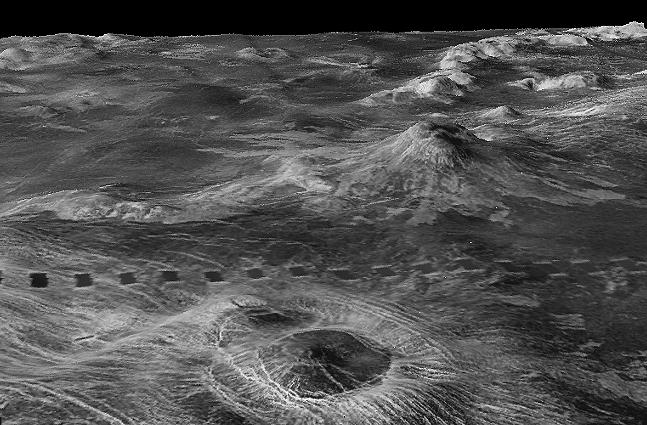
The surface of Venus is covered in volcanoes, mountains, valleys and craters. We know this because scientists used radar to look through the thick clouds. The craters are all very large because only large meteorites reach the ground. Smaller objects burn up in the thick clouds.
Several space agencies have sent spacecraft to Venus. The first were from the USA and the Soviet Union. In 1962, Mariner 2 passed above the surface of Venus and became the first space probe to visit another planet. More than 25 spacecraft have visited Venus since Mariner 2. In 1967, Venera 4 was the first probe to enter Venus' atmosphere. It measured the temperature, pressure, and chemicals in Venus' atmosphere. The first probe to land on Venus was Venera 7 in 1970. It sent information from the surface back to Earth for 20 minutes. Then the extreme heat and pressure destroyed the craft. From 1990 to 1994, the Magellan mission mapped the surface of Venus using radar.