

Pluto

Credit: NASA New Horizons
Pluto is a dwarf planet in the Kuiper Belt. Clyde Tombaugh discovered it in 1930. For over 70 years, Pluto was the 9th planet of our Solar System. In 2006, the International Astronomical Union decided Pluto should be in the new dwarf planet category. This category was created because astronomers had discovered 3 other objects which were a similar size to Pluto (Eris, Haumea, and Makemake). These 3 dwarf planets and Pluto are also known as Plutoids.
Pluto takes 248 Earth years to orbit the Sun. Its orbit is very elliptical. This means it takes a stretched-out, oval path, rather than a circular one, around the Sun. Pluto's orbit is also inclined to the orbits of the planets by about 17°.
On average, Pluto is 93 astronomical units from the Sun. It takes light from the Sun 5 and a half hours to reach Pluto. One day on Pluto takes about 153 hours and Pluto spins backwards, like Venus and Uranus. This means the Sun rises in the west, rather than the east. Though because Pluto is so far from the Sun, the light is much dimmer than on Earth.
Pluto is about 2500 km wide, which is three-quarters the size of Earth's Moon. It probably has a rocky core in its centre, surrounded by layers of ice.
Credit: NASA/ESA/Frattare
We know quite a lot about Pluto because the New Horizons space probe studied it for 6 months in 2015. Mountains, valleys, plains and craters cover its ice surface. The tallest mountain on Pluto is about 3 km high. This is bigger than the tallest mountain in the UK! Pluto also has a thin atmosphere made mainly of nitrogen.
Pluto has a very low temperature, which can drop to - 240 °C. It often gets cold enough for the atmosphere to freeze and fall as snow, but the snow is red! Pluto also has a heart-shaped glacier on its surface. This is named the Tombaugh Regio after the person who discovered Pluto.
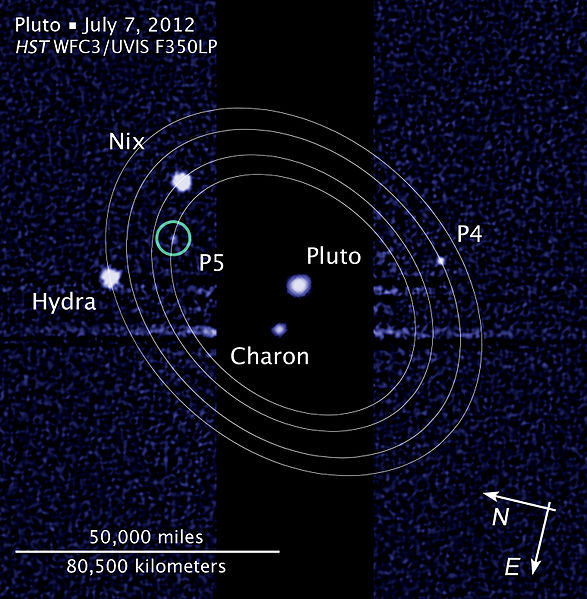
Astronomers have found 5 moons in orbit around Pluto. The largest, Charon, is around half the size of Pluto. The others (Hydra, Nix, Kerberos, and Styx) are much smaller.