

Neptune
Credit: Almond/NASA
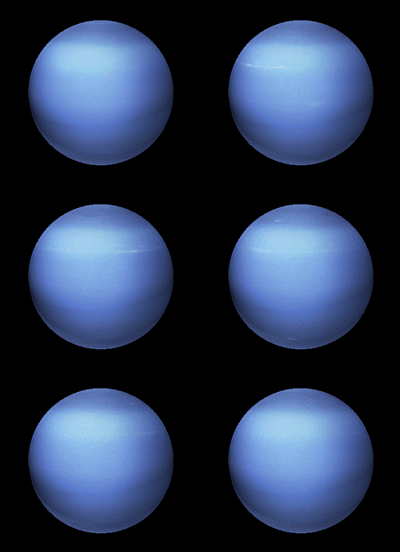
Neptune is the furthest planet from the Sun. About 30 times further away than the Earth is. It is a blue giant planet like Uranus. These planets are also called ice giants. They are made of mostly water, methane and ammonia ice, with a small rocky core.
Neptune is about 30 times further away form the Sun than the Earth is. Here the average temperature is -200 degrees C. It is so far away that it is the only planet we can't see from Earth without the help of a telescope.
The planet is about 4 times as wide as the Earth. It is also titled on its axis, by about the same amount as the Earth. This means that the planet has seasons like we do - but each one on Neptune lasts over 40 years!
Neptune's existence was predicted before it was ever seen. Astronomers noticed that the nearby planet, Uranus, seemed to have a strange orbit. It looked like Uranus was being pulled by another planet. Scientists used maths to predict where the planet should be, and in 1846 it was discovered. It is so far away from the Sun that since it's discovery it has only completed one full orbit, each taking 165 years!
Neptune has an atmosphere made of mainly hydrogen and helium. It also has the fastest known winds on any planet, with speeds of around 2000 km per hour.
Credit: NASA
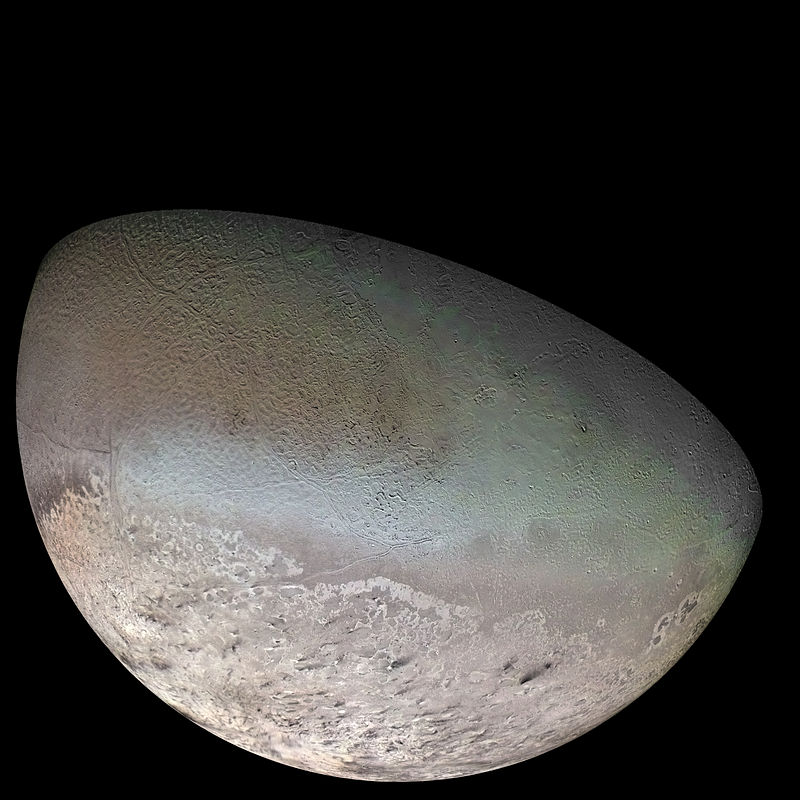
Neptune has 14 known moons. The biggest is called Triton. It is much larger than all of the other moons around Neptune. It has its own atmosphere and has been seen to spew icy liquid from its surface, much like geysers on Earth.
The only spacecraft to visit Neptune was Voyager 2 in 1989. This means there is still a lot we don't know about the planet. For example, what gives it such a bright blue colour?