

Mars
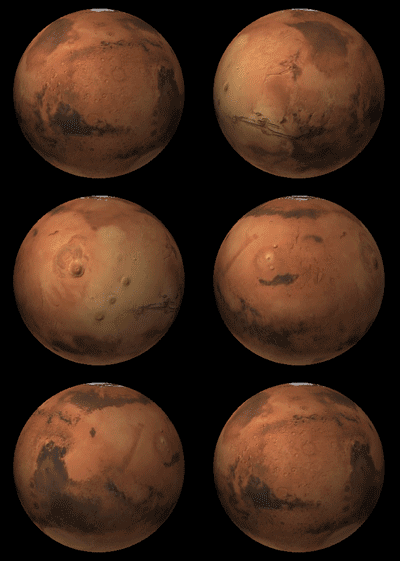
Credit:Almond/NASA
Mars is the fourth planet out from the Sun. It is also the second smallest planet in the Solar System after Mercury.
Mars is a terrestrial planet like Earth. This means that it has a solid surface you could stand on. It is made of minerals, metals and other elements that make up rock. Mars is often called the Red Planet. This is because it is covered with lots of iron oxide (or rust) giving it a reddish colour. It has two tiny, potato-shaped moons called Phobos and Deimos.
Mars is about half the diameter of Earth. As it is smaller in both size and mass the gravity on Mars is about 40% of that on Earth. Mars has a thin atmosphere mainly made of carbon dioxide (95%), argon (2%) and nitrogen (2%).
Mars has huge dust storms which can cover the entire planet and change how the surface looks. It also has polar ice caps mostly made of frozen water. There are lots of features on Mars which look like they were created by moving water a long time ago. If there once was liquid water on Mars it is possible that there was life.
Credit: NASA
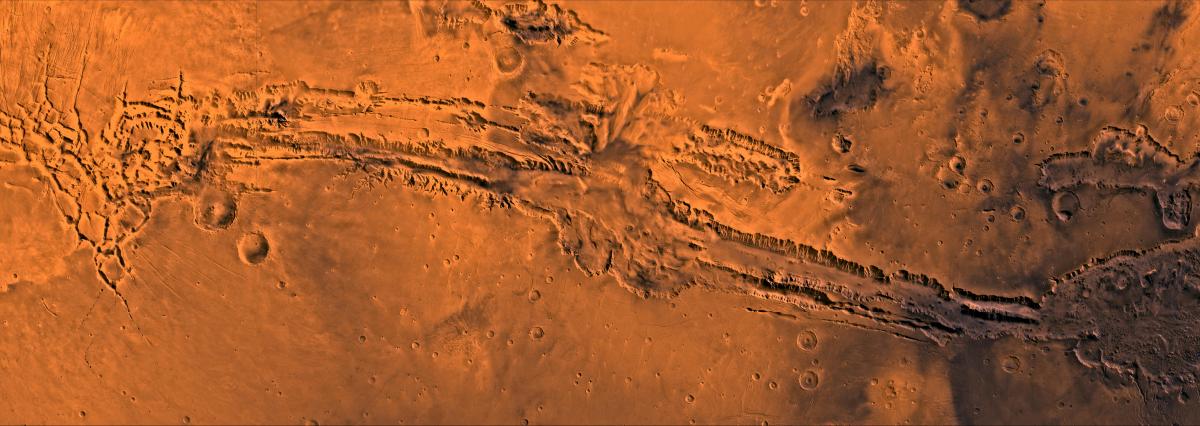
Mars is home to the largest volcano in the Solar System which is called Olympus Mons. It is about 3 times higher than Mount Everest on Earth. It also has the largest canyon in the Solar System called Valles Marineris. This canyon is more than 10 times longer than the Grand Canyon on Earth. If placed on Earth it would stretch across the whole of the United States.
Humans have sent probes to Mars since 1964. It's the only planet which robot rovers have landed on. There are still 2 rovers exploring the surface today; Curiosity (which landed in 2012) and Perseverance. Perseverance landed in February 2021 carrying on board a small helicopter. This helicopter was the first machine to have powered flight on another world! It was joined in May 2021 by the Chinese rover Zhurong Mars. They are all exploring the surface of Mars looking for signs of life.