

Europa
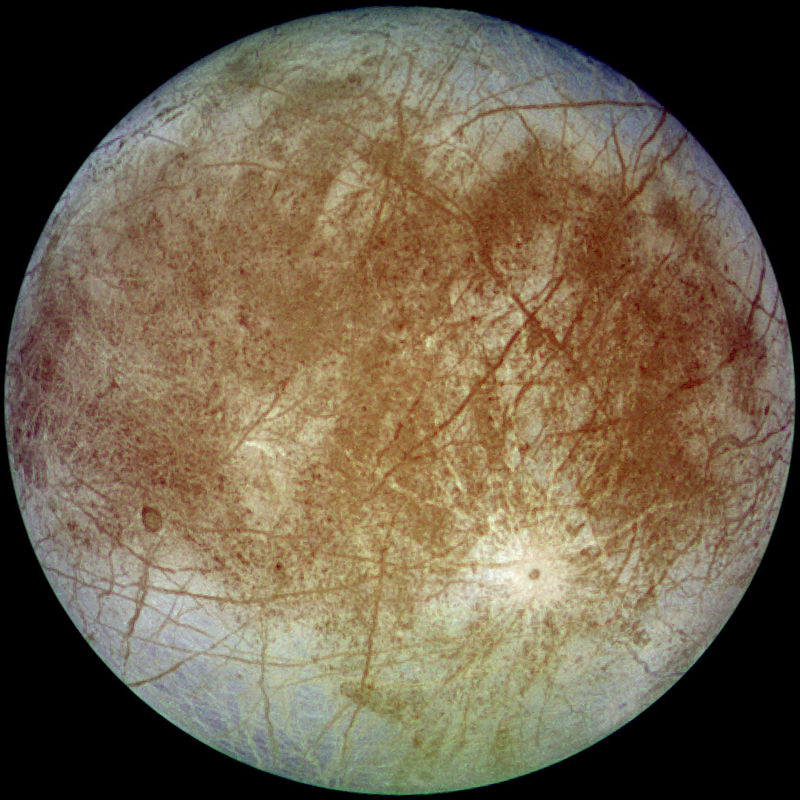
Credit: NASA
Europa is one of Jupiter's large moons. Like the other Galilean moons, Europa was first seen by Galileo Galilei in 1610. Europa is the only Galilean moon which is smaller than Earth's own Moon.
Europa's surface is made of water ice. Scientists think a huge ocean may be hidden under its icy surface. This means Europa could contain twice as much water as all the Earth's oceans put together! Europa also has a very thin atmosphere made mainly of oxygen.
The surface of Europa is unusual because it does not have many impact craters. This leads scientists to think any old asteroid impacts have been erased and the surface is fairly new. The surface is covered with a thick layer of ice, with lots of cracks in it. These cracks show up as dark lines streaking across the moon's surface in a crisscross pattern. It is thought these sorts of cracks form when surfaces melt, drift apart a little and then re-freeze.
In 2013, the Hubble Space Telescope made observations which suggested Europa was sending plumes of water into space. These plumes must be made by some kind of geology within the moon which suggests a source of heat. The presence of water, oxygen and heat makes Europa a good place to search for life!