

Earth
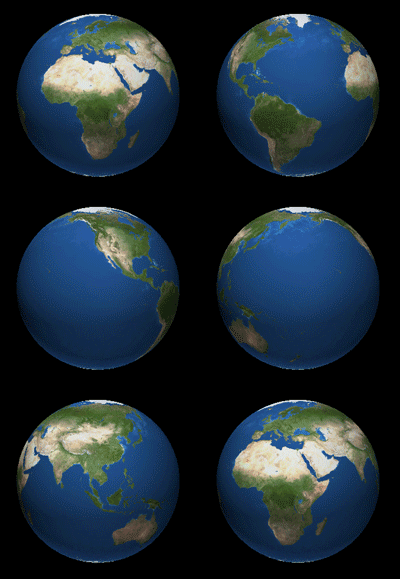
Credit: Almond/NASA
Earth is the third planet from the Sun. It is the largest of four rocky, or terrestrial, planets. It is the only place in the Universe where we know life exists.
Nitrogen (78%) and oxygen (21%) makes up most of the Earth's atmosphere. There are also tiny amounts of water vapour, carbon dioxide and other gases. Liquid water covers about 70% of the Earth's surface. Land covers the rest. The land is split into continents, islands, and polar regions. The polar regions are mostly covered with ice.
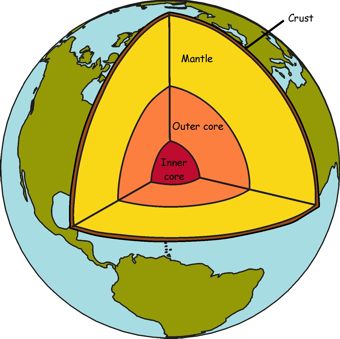
The inside of the Earth is split into layers. There is a solid iron core in the middle. This is surrounded by a liquid outer core. Around this is the mantle and a crust (see the diagram below).
The Earth turns on its axis as it orbits the Sun. Each turn takes 24 hours or 1 day. It takes 365.25 days, or one year, to complete an orbit around the Sun.
Credit: Wikimedia

The Earth has seasons because its axis is tilted by about 23°. When the northern half of the Earth (Northern Hemisphere) is pointing towards the Sun it has summer. At the same time the Southern Hemisphere is pointing away from the Sun and has winter. This switches as the Earth moves around its orbit.
Earth has one large rocky satellite, called the Moon. It is a natural satellite, meaning it is not human-made. It orbits the Earth once each 27.3 days. The Moon is the fifth largest natural satellite (or moon) in the Solar System.