

Ceres
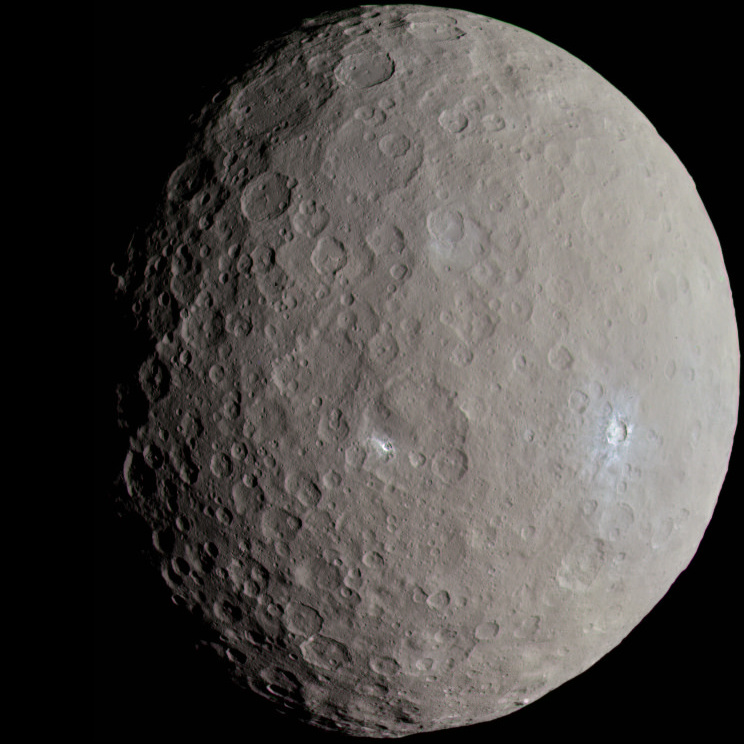
Credit: NASA/JPL-Caltech/UCLA/MPS/DLR/IDA/Justin Cowart
_(cropped).jpg)
Ceres is a dwarf planet between the orbits of Mars and Jupiter. It is also the largest object in the asteroid belt. Ceres was added to the dwarf planet category in 2006. Before then, it was called an asteroid.
The Italian astronomer, Giuseppe Piazzi discovered Ceres in 1801. Since then, astronomers have found 4 other dwarf planets. However, Ceres is still the only one in the inner Solar System. All the others are out past the planet Neptune.
Ceres is made of ice and rock. It is 930 km across which is about half the size of our own Moon. Ceres is so big it contains 25% of all the mass in the whole asteroid belt! But it is small for a dwarf planet. Pluto is 14 times more massive than Ceres. Ceres takes 4.6 Earth years to orbit the Sun. It rotates every 9 hours.
The Dawn spacecraft studied Ceres from 2015 to 2018. During that time, Dawn was in orbit around Ceres and made a map of its surface. The rocky surface is dusty and has lots of craters and large areas of salt. Though it is not the same as salt you would put on your chips (sodium chloride)! It's made from other minerals. Dawn also discovered that Ceres has ice volcanoes! These are volcanoes which release icy liquids, instead of hot lava.