

Callisto
Credit: NASA
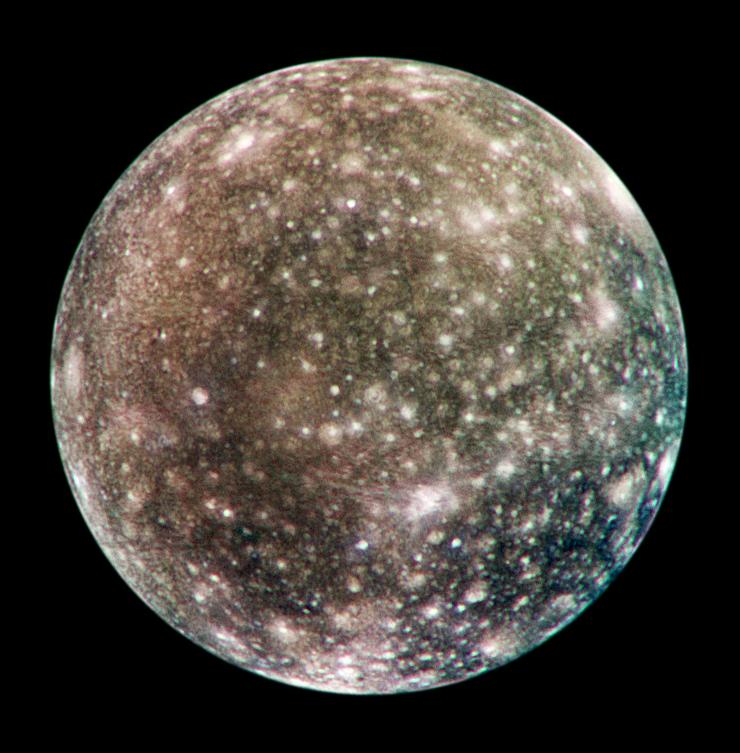
Callisto is the 2nd largest of Jupiter's moons. It is the 3rd largest moon in the whole Solar System. Like the other Galilean moons, Callisto was first seen by Galileo Galilei in 1610.
Just like Earth's Moon, Callisto is tidally locked to its planet. This means it makes an orbit of Jupiter in the same time it takes to rotate once on its axis. As a result, it always shows the same side to Jupiter.
Callisto is so big it is about the same size as the planet Mercury! However, it only contains about a third of the mass of Mercury, making it much less dense. The average density of Callisto is only twice that of water.
Scientists think Callisto is made of rock and ice. It may even have an ocean under its surface. The surface of the moon is surrounded by a very thin atmosphere. This atmosphere is made of carbon dioxide and may contain small traces of oxygen.
Callisto's rocky surface is covered in lots of craters. These craters were made by many asteroid impacts over a long period of time. Callisto does not show any signs of recent volcanoes or plate tectonics. This means the craters on its surface have remained there for millions of years. Scientists think the surface of Callisto is older than those of other moons and planets in the Solar System.