

Solar Eclipse
Credit: Luc Viatour
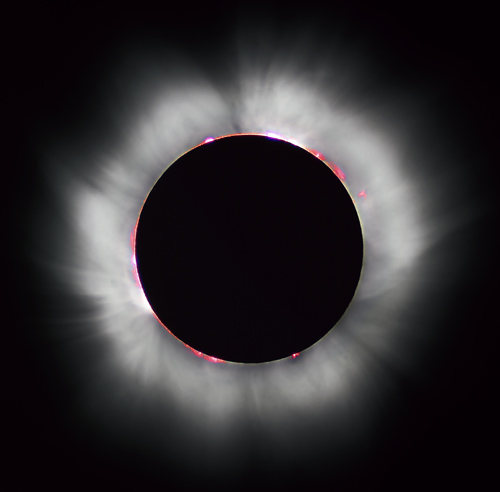
An eclipse is when an object passes through the shadow of another. A solar eclipse occurs when the Earth moves through the shadow cast by the Moon. The sky gets dark, like at night-time!
It is dangerous to look straight at the Sun. Even during an eclipse it is bright enough to damage your eyes. It could even blind you! Download the Solar Eclipse Guide (PDF) for safety tips on observing an eclipse. The guide was created by Royal Astronomical Society and the Society for Popular Astronomy.
 Download the Solar Eclipse Guide
The Moon is smaller than the Sun so how does it cause an eclipse? Well, the Moon is 400 times smaller than the Sun, but it's 400 times closer. This quirk of nature means the Moon and the Sun look the same size in the sky.
There are three types of solar eclipse:
- Total solar eclipse
- Partial solar eclipse
- Annular eclipse
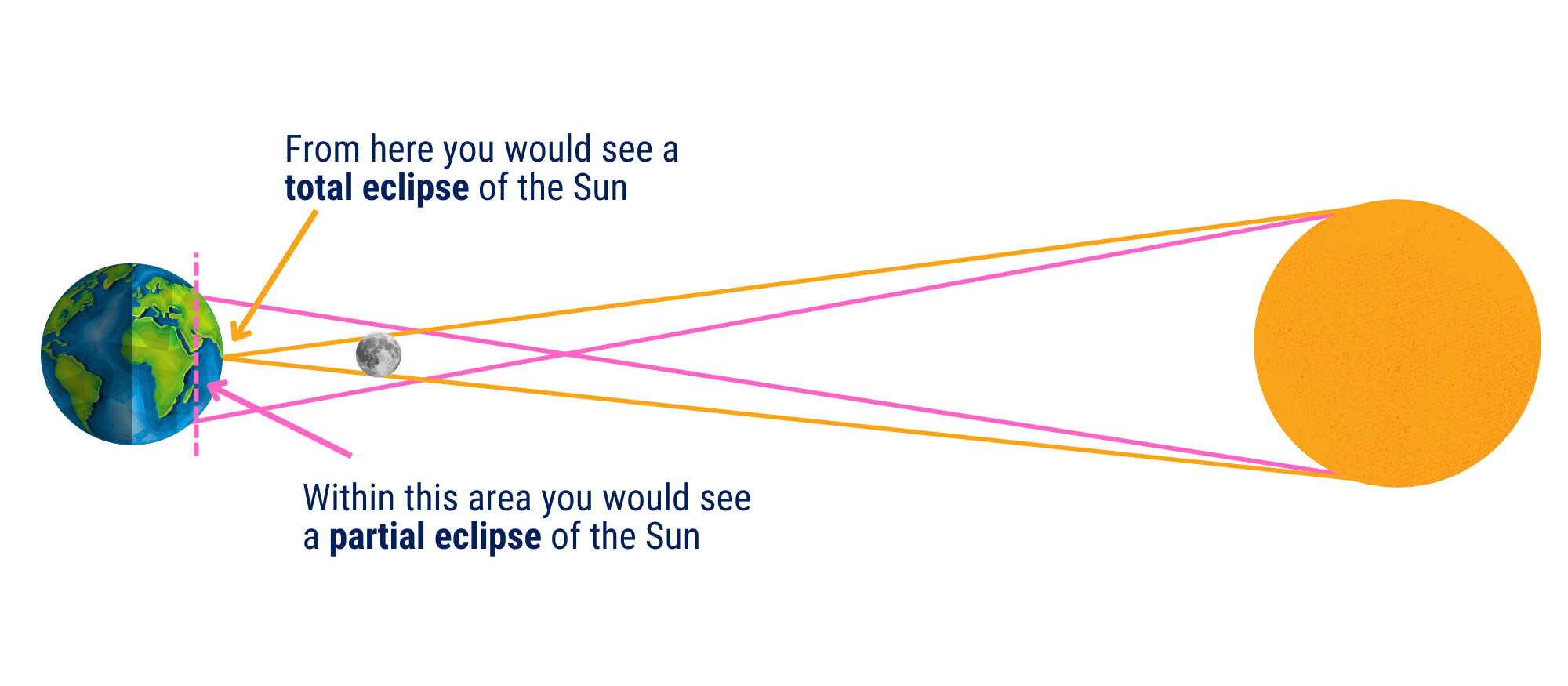
During a total solar eclipse the Moon completely covers the Sun. For this to happen, the Earth, Moon, and Sun have to be in a straight line. The Moon takes 27.3 days to orbit the Earth. So why isn't there a total solar eclipse every month? The Moon's orbit is on a tilt compared to the Earth's orbit of the Sun. It usually passes above or below the line between the Sun and the Earth. The times when all three objects line up, that's when we get a solar eclipse.
A total solar eclipse only lasts for a few minutes. This is because the Moon's shadow moves at 1,700 kilometres per hour! A total solar eclipse occurs on Earth roughly every 18 months. But the Moon's shadow only covers a part of the Earth's surface. So you have to be in the right place to experience a solar eclipse. And you have to wait 300 - 400 years to experience an eclipse in the same place twice!
Discover where in the world an eclipse will next take place.
Parts of the Earth not completely in the Moon's shadow see a partial eclipse. The Sun looks like it has a dark shadow on part of its surface. The sky gets darker, but it doesn't feel like night-time.
Credit: The Schools' Observatory
The Moon isn't always at the same distance from the Earth. When it's a bit further away, it doesn't look as big in the sky. This means it can't cover the Sun completely. We can still see a ring of the Sun around the Moon. This is called an annular eclipse.